
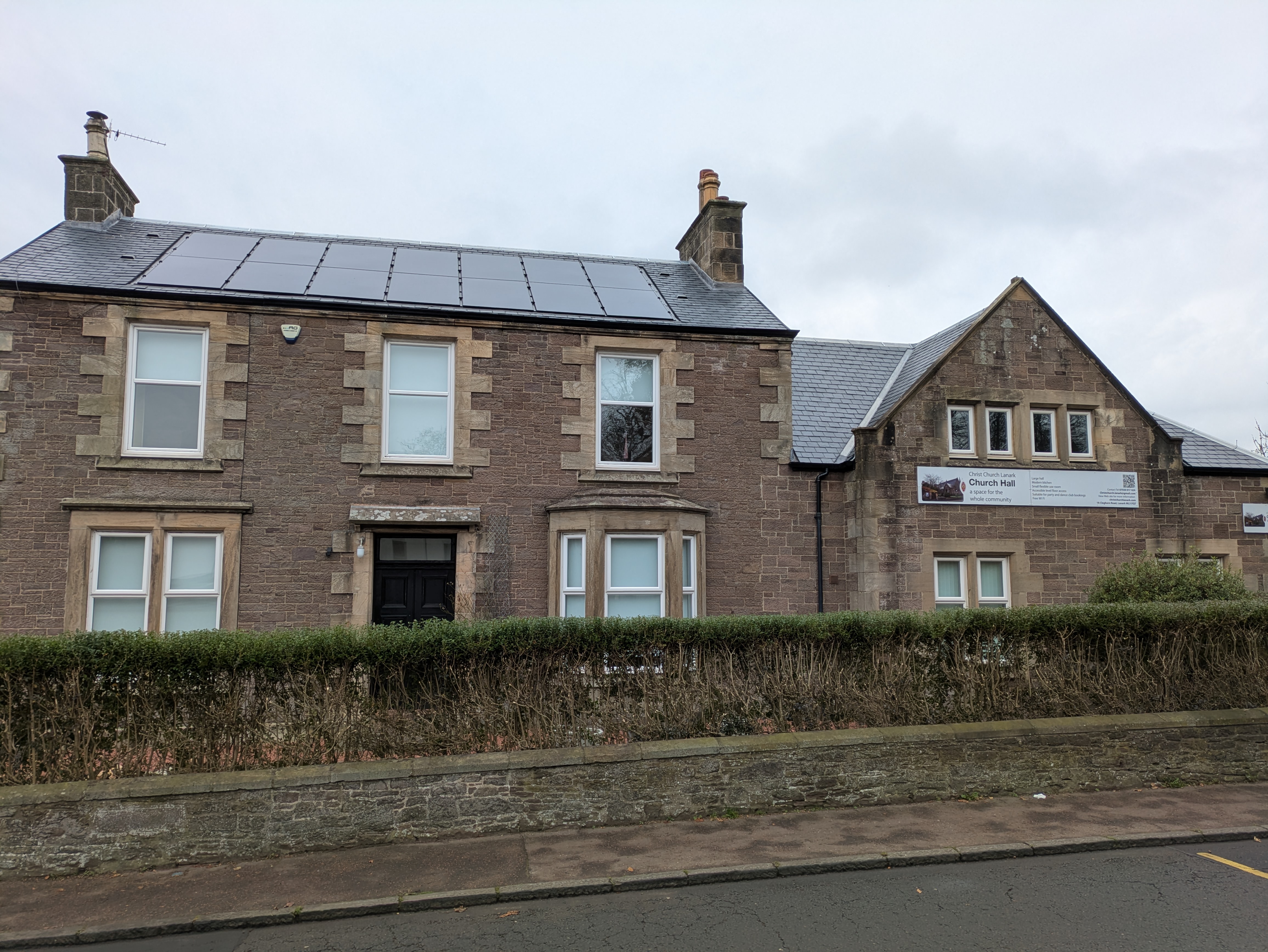
The background to how it started
The Vestry of Christ Church Lanark was keen to support the Province/Diocese in their drive towards Net Zero. With that in mind, they authorised the property committee to undertake some small projects to reduce our energy bills.
- We changed all our light fittings in both the church and church hall to energy efficient LED fittings.
- We installed Wi-Fi control to our gas central heating boiler in the church. This gave us the ability to remotely control the operation of the boiler.
- We also installed Wi-Fi control to the electric heating in the church hall. This enabled the hall convener to programme the heating remotely for the groups that rent the hall.
- Contact was made with Iain Johnstone, the Net Zero adviser for the Diocese. He advised us that our first step, if we were looking for grants to make improvements, would be to have an Energy Efficiency Assessment carried out. This took place at no cost to the church and has been the basis for all grant applications.
- In the church, we replaced our old industrial ceramic heaters to modern no-glow infrared heaters. Even though we reduced the power output of each heater from 4.5 KW to 3KW, they give greater comfort and reduced energy costs. The new heaters are programmable, remotely operated and thermostatically controlled, unlike the old ceramic heaters.
- Meanwhile, the money spent on property repairs has been escalating over the last few years and we knew that some roof repairs were urgent – leaks were causing the ceiling to fall in the church hall. Could we link re-roofing the church hall and adjoining rectory with the installation of additional solar panels, thereby saving on roofing costs and at the same time reducing our energy bills?


The funding journey
Vestry gave the property / net zero committee permission to investigate grant opportunities and the work elements required. We began regular online meetings with Ian Johnstone to develop our strategy going forward.
We were fortunate that we had an experienced project manager our congregation who helped pull the work elements specification together and begin sourcing quotations.
The committee received its first quote on the 9th September 2025 for lowering and insulating the hall ceiling. This element of work had been identified in the Energy Efficiency Assessment carried out a year before.
The Provincial Grant Fund was the most obvious place to start looking for funding for our improvements project listed above.
When you look at the Provincial grant application form for the first time your heart sinks. There is so much detail required and you wonder where you are going the find all this information. But, like every journey, it starts with the first step, and you find that various members of Vestry have the information you need.
We then looked at CARES grants which offered 80% grants for solar panels and batteries. This application was first meant to be submitted for March 2026. We missed the deadline despite everything being (we thought) almost ready.
The development of the specification for this project’s work elements took some time with the first quotes being rejected and second and third quotes requested. Taking the solar and batteries specification – after it was first quoted in line with what the property committee thought would bring the greatest efficiencies – we discovered CARES was more interested in generating energy than funding battery storage.
This meant we went back to the installers three times trying to agree a specification that CARES would fund. It was June when they agreed to fund the revised project of £20,000 of which they gave a grant of 80%.
In total, the property committee made five applications for grant funding for the above work elements. These were as follows:
- CARES: Exclusively for solar panels and batteries. We received £16,240.
- Business Savings Trust: For the lowering and insulating of the hall ceiling. There were two contractors involved – a suspended ceiling installer and an electrical contractor to alter cabling and install new lighting. We received £4,865.
- The Benefact Trust: They were keen to support the improvements we had proposed but they only give out relatively small amounts. We received £2,800.
- Provincial Building Grants Fund: It is important that you know when the next funding meeting is due to be held. They are only convened every 3 months, and all documents need to be in 3 weeks in advance. Our Diocesan office and architect in Glasgow gave good support filling in the application and ensuring any mistakes were corrected before it went before the funding meeting. We received £12,282. An additional £3,390 was awarded from the Provincial Net Zero Grant Fund.
- Provincial Rectory Green fund: After we completed a major application form for the replacement of the rectory roofing slates we only received £2,500. The reason given was that we had just received funding for the re-roofing of the hall. While we felt that was a rather disappointing response, thankfully, the Diocese matched the award from its own Green Rectory Fund.
- With the projects well underway we were delighted to receive a small grant of £500 from Lanark Community Council which was awarded in recognition of our efforts to provide for community use of the hall.
Re-Roofing of Hall with new slates
It was near the end of June 2026 when we received our letter from the Provincial office letting us know that we had been successful in our application for our improvements to Christ Church Community Hall and rectory. With a positive view to scheduling work the Roofers had been asked to plan for a start on 6th July 2026. So, when Bishop Nick arrived to take a Confirmation service on 5th July, scaffolding was in place and a skip was on site.


Vestry was keen that the work should go ahead during the summer months. Work started on the hall roof first as this roof over the last few years had been leaking and making sections of ceiling fall down inside. The work proceeded as planned with no major wood rot being found and only minor delays due to wet weather. Gutters were replaced where required; all chimneys were repointed and lead valleys renewed.
The complete roof was re-slated with Spanish slates. The work on the hall roof also necessitated the temporary removal and subsequent replacing of the existing solar panel arrays which have in situ for some years, and which provide a steady income to congregational funds.
The hall re-roofing did not stop any groups from using the hall and all work was completed by 21st August 2026.
Re–Roofing of the Rectory with new slates
The roofers moved straight on to the rectory roof and, as you will read in the section below, the timing of the work was key. The re–roofing of this section provided some challenges. Scaffolding was erected and the work began with stripping the slates on the front elevation.
The nails were poor on the old slates but also the timber sarking had become loose because the timber nails were poor also. All the sarking had to be re-nailed and facias that supported gutters had to be secured and some timbers replaced.
This completed, the roof was felted and the solar trays fitted. Roofers returned and slated around the new trays. There had been a section of the roof replaced with Spanish slates some years before. The detailing of this work was checked and improved and, by the end of September 2026, this roof was complete.
Solar panel and batteries installation
There are plenty of installers keen to quote for the installation of solar panels and battery storage. We had good help from our installers as to the most efficient way to design and deliver the project. With the availability of tray mounted solar panels we realised that, if we rolled the delivery of the re–roofing project together with the solar panel installation there were big savings to be made, the reason being two-fold:
- if both installers use the same scaffolding that would save approximately £3,000
- if we stripped the old slates off and felted the roof, the solar installers could fit the trays ready to receive the panels meaning the roofing contractor would not have to fix slates under the trays.
Again, this saved approximately £3,000 and this saving was built into the specification that both the contractors quoted on.
All parties worked to a strict timetable with both contractors getting access to the scaffold when their portion of the work was available to be carried out. Both the re–roofing and the solar installation were finished by the end of September 2026.

Lowering and insulation of the hall ceiling
The hall was out of use for six days and during that time the character of the inside of the building changed significantly.
Some preparatory work was carried out prior to the start date of 7th September 2026. Electricians installed some cabling to facilitate lights in the lowered ceiling. We also installed ‘mood’ lighting that can be used by dance and yoga groups or people using the hall for parties. This was not covered by the grant funding.
After the Sunday tea and coffee on 6th September we cleared the hall ready for the contractors who arrived on Monday 7th. It was then all action with materials arriving and all the trades working together. By the Thursday, the insulation had been installed and all we had to do was get the hall floor cleaned on the Friday. On Saturday congregation volunteers arrived, and the hall was set up ready with tables and chairs for the Sunday teas and coffees.
The lowering of the hall ceiling has had the biggest impact on user groups and the congregation. The hall is much warmer and there is less echo; it also has a more homely feel with the lower ceiling.
The ‘mood’ lighting has an iPad fixed on the wall that each user group can use to set the atmosphere they feel is appropriate to them. Alternatively, the normal warm white LED ceiling lights can be used with no fuss.
All the work was completed by 11th September 2026.
Summary
The completed ‘three-element’ project took a lot of commitment from the Vestry and our property committee. We stepped out in faith knowing that any shortfall between costs and external grant fundings would result in a draw-down from congregational reserves and the potential loss of future income from our invested capital.
Total costs of our projects have totalled £67,500. Of this, total grant funding received has amounted to ~£45,000. Congregational members (past and present) have donated sufficient funds for us to close off this particularly busy and, at some times, testing year with a retention of monies to carry forward for potential works to maintain and improve our church plant.
We have also carried out some additional works that would have been probably have been highlighted in our Quinquennial report that is due next year 2027.


John Wilcox, Church Energy Manager, Christ Church Lanark


