
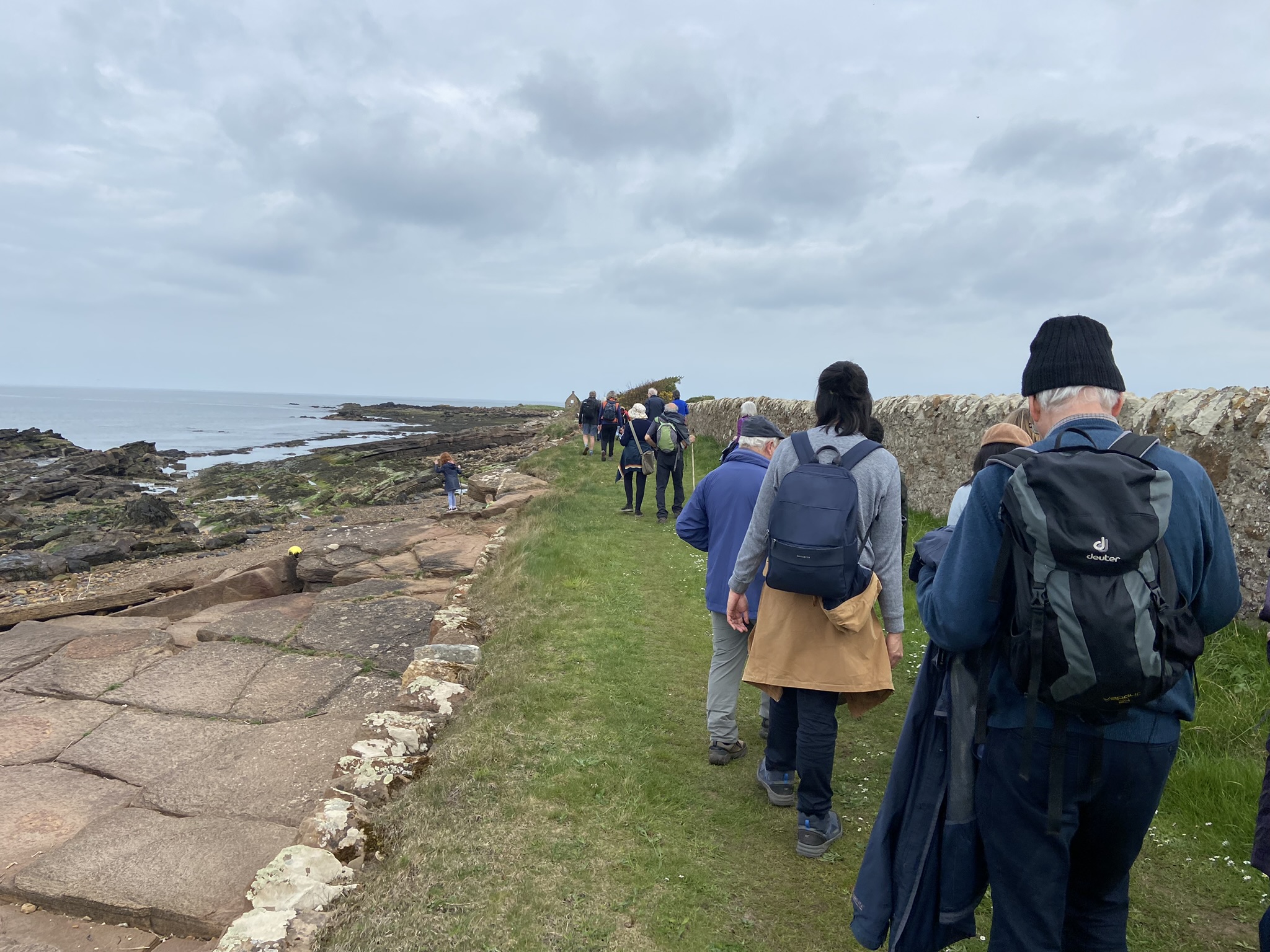
Saint Andrew’s church, in St Andrews, Fife recently celebrated Rogation Sunday with a prayer walk past fertile fields, through beautiful bluebell woodland and out to the glorious Fife coast. The word Rogation comes from the Latin Rogare, ‘to ask’, and historically Rogation Sunday is a time to ask God to grant a fruitful harvest. Fife is home to some of the richest agricultural land and coastal habitats in Scotland. Yet with the pressures of soil degradation, over-fishing and changing climates, the varied habitats we walked through on Sunday are increasingly fragile. The day was a wonderful mix of celebrating new life and growth, alongside the challenging call for each of us to care for creation.

Alan Werritty (member of the Saint Andrew’s Eco Congregation Scotland group and Emeritus Professor of Physical Geography) spoke during the service of our call as humans to partner with God in restoring creation. He re-launched the Saint Andrew’s Green Ticket Scheme as a way of encouraging the congregation to reduce their carbon footprint.
The Green Tickets can be filled in on paper or digitally, and either as a written description of a recent, sustainable choice that an individual has made, or numerically as a carbon saving. Details of how to calculate the carbon emissions saved are found in the Green Ticket Scheme Handbook. However big or small a saving, or sustainable choice may be, these Green Tickets are added to the offering plate as part of the congregations’ giving to God. This simple act highlights the way that the decisions we make in our daily lives are part of our worship; and the sacrifices we make financially are all part of our giving.
The words from the closing hymn spoke of the challenges we face, in light of the incredible truth that we journey in partnership with Christ: “Then grant us grace, Companion-God, to choose again the pilgrim way and help us to accept with joy the challenge of tomorrow’s day”.


After the service, the Rogation Sunday celebrations continued with a picnic lunch in a local village hall at Boarhills, followed by a prayer walk led by Rosalind Garton. Members of the St Andrews Churches Eco-Network joined the Saint Andrews congregation for the afternoon. Whilst walking, a list of flora and fauna were recorded, thanks to the expertise of Rosalind, Mary Macintyre and contributions from the rest of the group. 49 flowering plants were spotted, including bluebells, celandine, wood anemones and honesty; 24 birds were seen or heard, including chiffchaffs, skylarks, blackcaps and sandwich terns; and 3 invertebrates were recorded. The full list of flora and fauna can be found below.


As we ate, walked and chatted, there was a sense of joy in the diversity of flowers, birds and insects around us, and a renewed commitment to the challenge of reaching net zero carbon.
Saint Andrews church has already worked hard to improve their energy efficiency and reduce their carbon footprint. In 2020, they received a Community Climate Asset Fund, which enabled them to install secondary glazing in the hall. In 2022, CAREs funding enabled insulation of the hall, updated heating controls, and installation of solar PV and solar water heating panels. These solar panels were approved by Fife council and Canon 35, despite the B-listing of the church building, and the conservation status of the area.
Upcoming plans include upgrading to LED lighting, exploring additional PV panels, and replacing the gas boiler with an alternative heating system. The church has switched to using a renewable energy tariff and the garden is already being used to grow flowers and food, with participation from the Young Church. All these achievements, and upcoming plans, are a huge encouragement as other churches embark on the net zero journey.


Bethany Nelson, Empowerment Coordinator


