
St Mary the Virgin is a beautiful, A-listed, stone building, which sits at the entrance to the stunning Dalkeith Country Park. The church is bound by the Buccleuch Estates covenants and, as with all listed buildings, has faced challenges with sustainable heating solutions and rising energy bills.
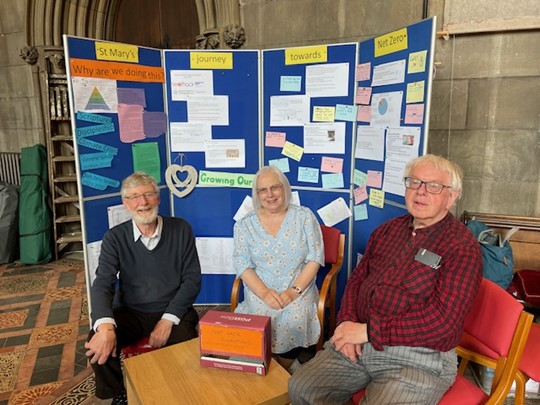
St Mary’s decided to use the HeatHack workshops to help improve their energy efficiency and plan for a net zero future. Dr Pauline Jones set up a small group and facilitated four sessions at the church. The group included a representative from the vestry.
Data loggers were positioned in four areas of the church to provide heat profiles i.e. information on which parts of the buildings were warm at what times. These heat profiles could then be matched to the church’s diary of events, and to the group’s knowledge of where in the building these events took place. For example, the 30-40 strong congregation meets weekly for worship on Sundays, whilst smaller groups meet for coffee mornings and community events at the back of the church near the kitchenette. There are also one-off events such as weddings and funerals that require the use of the whole building.

After looking at the data collected, the group realised that the 100kWh gas boiler takes six hours to warm the church to a maximum temperature. The building then holds its heat for a long time. This highlighted that a lot of energy and money was being used to enable small groups to use small areas of the building, often for two-hours at a time.

So, what have St Mary’s done since the HeatHack workshops? The good news is they have reduced their carbon emissions, and saved a third of their gas bills, at very little upfront cost. They achieved this by changing the heating settings to utilise the warmth retained within the building after the heating had been switched off. Whilst it seems counter-intuitive to turn the boiler off before a service starts, it also makes no sense to leave a building nice and warm for hours after everyone has left! Making this change was quick, easy and free of charge; however, the church did install Hive to enable easy adjustment and monitoring of heating controls.
The church also insulated the heating pipes within the boiler room, which they did themselves at very little cost, and switched to a green, renewable electricity tariff. St Mary’s have also worked with St Leonards to install solar panels on the joint rectory, which were kindly gifted to the charge. They have leased an EV car and installed charging points at the rectory and in St Mary’s car park.
In the future, St Mary’s plans to move away from using its gas boiler to reach net zero carbon. Implementing this has current complications as the church has a single-phase power supply. A quote of £11k has been given to upgrade this to a three-phase supply. St Mary’s is in the process of drafting a CARES grant application for this retrofit project.
The dedicated work to care for creation at St Mary’s has been spurred on hugely by the passion and expertise of Revd Dr Valerie Cameron (Curate Deacon at St Mary’s and a member of the PEG). Val says “I can recommend the HeatHack process to any congregation. The facilitator training is clear and easy to deliver to a church group and helps to identify issues where energy usage can be reduced, resulting in financial savings and reduction in greenhouse gas emissions.” So next time you’re booking in for a Go-Ape experience in Dalkeith Country Park, or planning a coffee at the Restoration Yard, take time to stop by and visit this beautiful building, which demonstrates how to spend little and save lots.
Bethany Nelson, Empowerment Coordinator


