
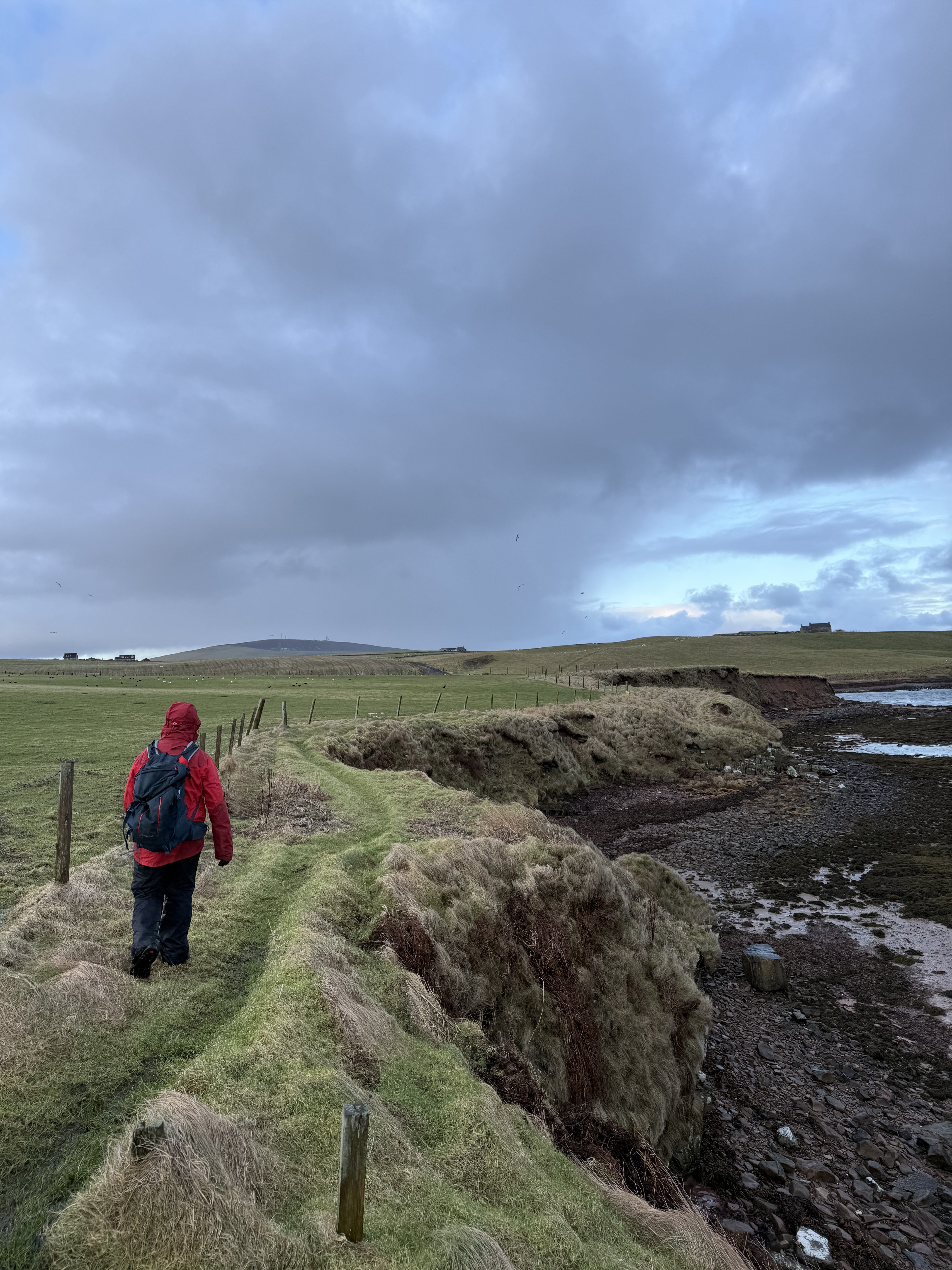
Earlier this month, Jack Nevin (Net Zero Innovation Coordinator and primary contact for the Diocese of Aberdeen and Orkney) visited St Mary the Virgin in Stromness and St Olaf’s in Kirkwall, Orkney. Jack made site visits, met with vestries to discuss energy use and possible future projects, and took the opportunity to walk part of the St Magnus Way.


The St Magnus Way is a relatively new pilgrimage route, having been established in association with the 900th anniversary of the martyrdom of St Magnus in 2017. The Way is a long-distance pilgrimage route through Mainland Orkney, following the story of St Magnus and giving time and space for reflection.
Recently named among the top 10 Scottish pilgrimage routes by the British Pilgrimage Trust, the St Magnus Way is a 58-mile journey from Egilsay to Kirkwall incorporating coastal walking, inland track and road walking, hill climbing and a forest walk. There is an additional cycle route and smartphone app to guide pilgrims.

The Way is split into six main sections, each with their own distinctive identity and terrain, allowing for pilgrims to either tackle a short section or the entire route, at their discretion. Starting from Egilsay, the Way leads pilgrims to various sites related to Magnus’ martyrdom. These sites include the route Magnus’ body was carried to his burial in Birsay, the site and monument of his death, and sites of his shrine and churches he built.
The pilgrimage finishes at the Cathedral which bears his name, a six-minute walk from St Olaf’s Episcopal Church. St Magnus’ Cathedral is owned by the Orkney Islands Council and is both the oldest and most northernly cathedral in Scotland – it is a place for all Christian denominations, and the congregation of St Olaf’s hold a weekly prayer service in the St Rognvald’s chapel.
The St Magnus Way takes a rough and varied route, challenging pilgrims with the diversity of terrain and elevation. Not to mention the Orcadian weather, which proved a challenge when Jack completed the final three miles of the Orphir to Kirkwall portion.


Along with a member of the congregation of St Olaf’s and trustee of Orkney Pilgrimage, Stuart Little, Jack quietly appreciated the ancient and modern history of Orkney – passing Scapa Flow, the largest natural harbour in the Western Hemisphere and site of the sinking of the Royal Oak and reflecting on the theme of the portion, ‘hospitality’. Jack reflected on our beautiful gift of creation, and how charges all have a role to play in protecting our environment as we journey to a more sustainable church.
In speaking with Sheila Garson, Chair of Orkney Pilgrimage, Jack learned more about the environmental challenges faced in Orkney, as well as the narrative of the Way. Sheila’s perspective is provided below. Should you wish to learn more about the Way, or walk it yourself, you can find more information here.
What challenges have you faced with regards to the natural environment and what is the future perspective on this?
There are short portions of the route that have been impacted by costal erosion, but as an island community this is nothing new and it’s a case of working with landowners to make adjustments to the route when needed.
Land in Orkney is predominantly owned by owner occupier, family farms rather than big estates and therefore landowners are rooted in their community. As a charity dependent on the goodwill of our community, we need to be sensitive in our approach and work with landowners and other groups to find mutually beneficial solutions.
There can also occasionally be issues with flotsam and jetsam along the shore line following winter gales, but this usually resolves itself.


What do you find calls pilgrims to the Way?
The St Magnus story is my first reaction to this. For example, we have groups visit from Norway where there are strong links to St Magnus and a school in Australia is planning a visit this year because St Magnus is their patron saint. Having said that there are also pilgrims who want the challenge of a new Way.
We only know what has inspired visitors if they reach out to us and it would be fair to say that this is probably the minority of folk who use the Way. We also know many locals use portions of the Way as regular walking routes and there are some who have even run the Way.
I felt grounded and connected to Orkney as I navigated a portion of the way – both the modern and ancient histories. Was there an eye to create a silent narrative in establishing the way?
Orkney’s past is ever-present in its landscape; from its geology and archaeology right up to the 19th century agricultural improvements. Some of the more significant sites are highlighted along the Way and perhaps this raises awareness and adds to that sense of connection. That closeness to nature; the birds, flora and fauna, wildlife are all there too.
Orkney is small is many ways, but packs a punch because of all the above and that is woven into the Way and those in turn will find that feeling of connection.
Jack Nevin, Innovation Coordinator


